March 11, 2026
Hurricane Season Is Coming: Your Northeast Florida Tree Prep Checklist
Hurricane season runs June 1 through November 30 in Northeast Florida — six months when a single storm can drop a 60-foot pine through your roof or strip half the canopy off your live oak. The good news: most hurricane-related tree damage is preventable. The bad news: most homeowners only think about their trees after a storm hits, when crews like ours are booked weeks out.
Here's a checklist of what to do before hurricane season — ideally in May or early June — to protect your Jacksonville-area property.
✅ 1. Identify Hazardous Trees Now
Walk your property and look for:
- Trees leaning toward your house, garage, fence, or car
- Dead trees or trees with large dead branches
- Trees with cracks, splits, or hollow cavities
- Trees with fungus growing on the trunk
- Pines with brown needles or thinning canopies (could indicate pine bark beetle)
If you see any of these, get them assessed now. A pre-storm removal costs a fraction of post-storm cleanup, and you skip the insurance claim drama.
✅ 2. Pull the Deadwood Out of Your Canopies
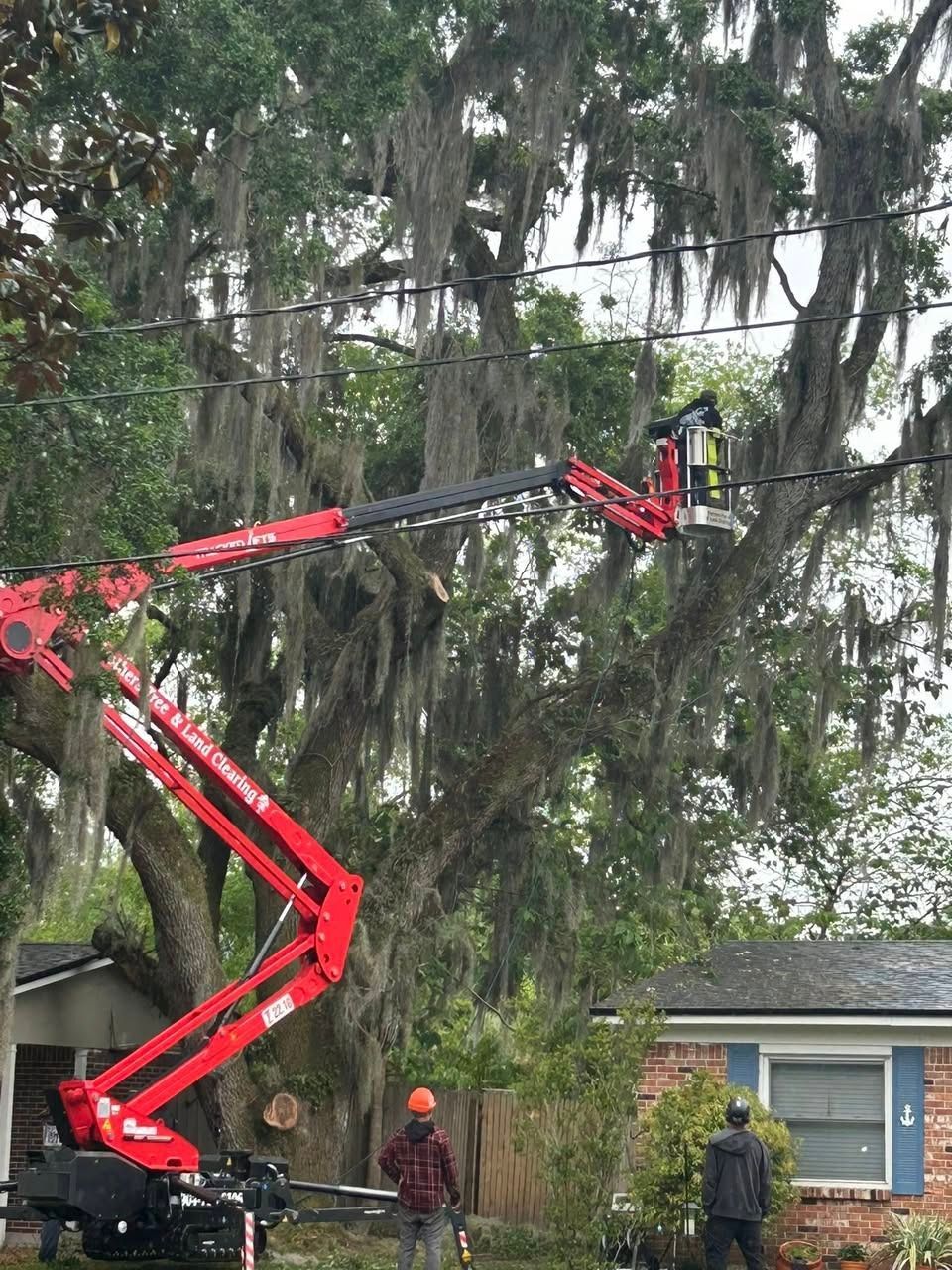
Deadwood — those dead branches hanging up in healthy trees — is the number-one source of hurricane-related property damage. The tree itself might survive a 90-mph wind just fine, but the dead branch in its canopy turns into a projectile. Brother's Tree & Land Clearing does pre-hurricane deadwood removal across Jacksonville every spring; it's one of our most-requested services in May.
✅ 3. Thin Dense Canopies to Reduce Wind Load
Mature live oaks and water oaks in older Jacksonville neighborhoods often have dense canopies that catch wind like a sail. Proper thinning — done to ANSI Z133 standards, not "topping" — reduces the wind load on the tree, lowering the chance of structural failure. Done right, thinning extends the tree's life. Done wrong (i.e., topping), it ruins the tree's structure permanently.
✅ 4. Trim Branches Away From Your Roof and Power Lines
Anything overhanging your roof is a roof leak waiting to happen. Anything touching JEA primary lines is a power outage and possibly a fire risk. Pull branches back at least 6 feet from your roof, and have utility-line clearance done by professionals who coordinate with the power company.
✅ 5. Get Storm-Damaged Trees Removed Before Next Season
If a tree took damage in last year's hurricane season but is still standing, don't assume it'll make it through another one. Wounded trees with cracked limbs or partial uprooting are weakened — they fail faster the next time. We see this every year in Jacksonville Beach, Atlantic Beach, and Ponte Vedra, where wind exposure is highest.
✅ 6. Clean Out Yard Debris and Loose Items
This isn't tree-related, but it goes hand in hand: pick up any loose lumber, pots, furniture, or branches in your yard. In a hurricane, anything that isn't bolted down becomes a projectile.
✅ 7. Document Your Property With Photos
Before storm season, take photos of your healthy trees and property. If damage happens, having "before" photos makes insurance claims dramatically easier. We provide written documentation for storm-damage claims for our customers.
✅ 8. Know Who to Call
The week after a major hurricane, every tree service company in Jacksonville is slammed. Customers who already have a relationship with a tree service — quote on file, account established — get served first. If you don't have a tree service you trust, get on a list now.
Book Your Pre-Hurricane Tree Work With Brother's
May and early June are our busiest pre-hurricane months. We do deadwood removal, canopy thinning, hazardous tree removal, and full storm prep across Jacksonville, Mandarin, Ponte Vedra, Orange Park, Fleming Island, Fernandina Beach, and surrounding NE Florida communities. All licensed, fully insured, and backed by a free written quote.
Call 904-718-6306 before the next storm rolls in.
ADDITIONAL BeaRS STORIES